


Quick answer
Hiring a startup CEO is not the same as filling a normal senior role. The best candidate is the person whose pattern of judgement fits the company stage you are entering, not the person with the most impressive title history. Start by defining the mandate, agree the decision rights with the board and founders, build a measurable scorecard, run a confidential search across founder networks and passive executives, and test candidates through evidence-based interviews, references and a 100-day operating plan.
Why hiring a startup CEO is different
A startup CEO is hired into uncertainty. In a larger company, the CEO often inherits departments, reporting lines, dashboards and a mature operating rhythm. In a startup, the CEO may have to create the rhythm while also raising capital, recruiting leaders, keeping the board aligned and protecting the product vision.
That is why stage fit matters more than generic leadership language. A seed-stage CEO may need to sell the vision personally, close the first enterprise customers and keep product direction tight. A Series A or B CEO may need to turn founder energy into repeatable systems, hire a leadership team, build a board cadence and make the company fundable. A later scaleup CEO may need to professionalise forecasting, management layers, international hiring and governance without slowing the company down.
Research on founder-CEO succession shows that the need for a new CEO often appears after success, not only after failure. Product progress, funding rounds and growth can all change the leadership job. A founder who was perfect for discovery may not be the right operator for scaling. Equally, replacing a founder too early can remove product intuition, mission credibility and cultural memory. The hiring process has to deal with that tension directly.
When should a startup hire a CEO?
There are five common moments when a startup should consider hiring a CEO or bringing in an external CEO profile.
- The founder wants to move into a product, technical or chair role. This is common when the founder is still essential to vision and product but no longer wants to run every operating function.
- The business has raised institutional funding and needs a stronger operating cadence. Investors may expect clearer forecasting, board reporting, executive hiring and revenue discipline.
- The company is moving from founder-led sales to a repeatable go-to-market engine. This is often the point where the CEO role changes from evangelist to builder of a commercial machine.
- The leadership team is underdeveloped. If hiring a VP Sales, CTO, CFO or COO keeps stalling because no one owns the executive standard, a CEO search may be the real need.
- The company is preparing for acquisition, international expansion or a major funding round. In these moments, credibility with investors, buyers, senior candidates and strategic partners becomes part of the CEO’s job.
The wrong reason to hire a CEO is vague discomfort. If the board simply says the company needs adult supervision, pause. Translate the concern into outcomes. Do you need better cash discipline, enterprise sales leadership, product focus, investor confidence, faster hiring or clearer accountability? Until that is named, the search brief will drift.
Define the CEO mandate before writing the job description
A useful CEO brief starts with the mandate, not the CV. The mandate should answer four questions.
What must change in the next 12 to 24 months? Examples include reaching product-market fit, moving from founder-led sales to repeatable revenue, preparing for Series B, entering the US market, reducing burn, replacing a weak leadership layer or building a category brand.
What must not be broken? This may include product quality, founder trust, customer intimacy, engineering culture, brand voice or speed of decision-making. Many external CEOs fail because they import a big-company playbook that damages the very thing that made the startup promising.
What decisions will the CEO own? Clarify authority over hiring, budget, fundraising, pricing, product trade-offs, executive exits, board communication and founder responsibilities. If the founder remains in the business, write down the working relationship before candidates enter the process.
What evidence would prove success after 100 days, 12 months and 24 months? The first 100 days may be about diagnosis and leadership alignment. Twelve months may be about executive hires, pipeline quality, retention, financial control and board confidence. Twenty-four months may be about funding, market expansion or exit readiness.
Build a scorecard around outcomes, not adjectives
A CEO scorecard stops the process becoming a charisma contest. It should be short enough for every interviewer to use and specific enough to create real trade-offs.
A strong startup CEO scorecard usually includes:
– Stage fit: has led through a similar level of ambiguity, funding pressure, team size and market motion.
– Capital judgement: understands runway, fundraising, investor communication, pricing and resource allocation.
– Go-to-market leadership: can diagnose whether growth depends on sales, marketing, product-led growth, partnerships or customer success.
– Product and technical fluency: does not need to be the CTO, but must understand the product deeply enough to make strategic trade-offs.
– Executive hiring: has recruited, assessed and managed senior leaders who are better than generalists.
– Board and founder alignment: can build trust without becoming political or deferential.
– Operating cadence: knows how to turn strategy into targets, meetings, metrics and accountability.
– Culture under pressure: can make hard decisions without creating fear, confusion or churn.
Weight these criteria. A pre-revenue deep-tech company may weight product and fundraising heavily. A SaaS scaleup with uneven revenue may weight go-to-market and management cadence. A marketplace company may need a CEO who understands liquidity, unit economics and network effects.
Where to find CEO candidates
The best startup CEO candidates are rarely applying to job adverts. They are usually running something, advising founders, sitting inside a scaleup, operating as a divisional leader, preparing for a portfolio CEO role or quietly considering their next move.
Start with investor and founder networks, but do not stop there. Warm introductions create trust, yet they can also narrow the field to people who already look familiar to the board. A serious search should include:
– Former founders who have scaled beyond your current stage.
– CEOs who have run investor-backed companies through a similar growth phase.
– COO, CRO, CPO or GM profiles who have carried full commercial or operating responsibility.
– Sector specialists who know the customer, buying cycle, product constraints and hiring market.
– Interim executives who may know the company before committing to a permanent role.
– Diverse leadership networks that prevent the board from recycling the same candidate archetype.
For technology companies, CEO hiring often overlaps with tech recruitment because the leader must understand product, engineering capacity, technical credibility and the senior talent market. A specialist search partner can help turn that into a stronger candidate map rather than a narrow list of obvious names. Founders comparing C-level search options can also review https://wundertalent.co.uk/c-level-recruitment/ while building the longlist.
How to run a CEO hiring process
Treat the CEO search like a strategic project. A typical process should include seven stages.
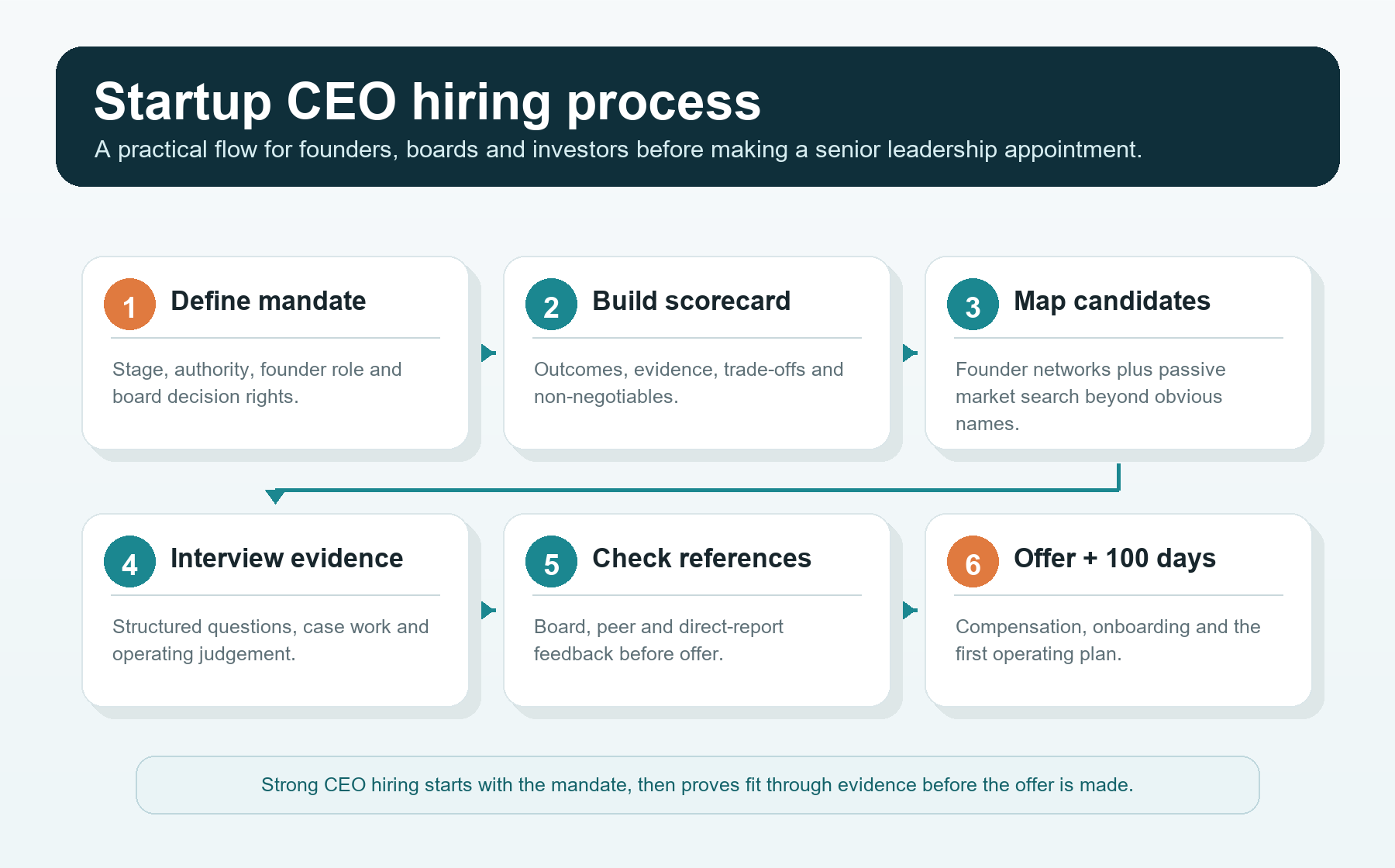
- Alignment session. The founders, board and key investors agree the mandate, decision rights, compensation range, confidentiality rules and timeline.
- Market mapping. Build a longlist by stage, sector, leadership path, funding experience, geography, availability and reputation.
- First calibration interviews. Speak to a small number of different candidate profiles before locking the brief. This helps reveal whether the market agrees with your assumptions.
- Structured interviews. Use the same scorecard across candidates. Ask each interviewer to own a theme such as capital strategy, go-to-market, product judgement, leadership hiring or founder transition.
- Case discussion. Do not ask for unpaid consulting. Instead, use a realistic board-level scenario: runway has shortened, growth has slowed, the CTO is overloaded and two enterprise deals are at risk. Ask how the candidate would diagnose and sequence decisions.
- Deep references. Speak to former board members, direct reports, peers and investors. Look for patterns under stress, not just general praise.
- Final alignment. Before the offer, confirm the operating model between CEO, founder and board. This includes who speaks to investors, who makes executive hiring decisions and how disagreements will be resolved.
The process should be fast but not rushed. Strong CEO candidates will judge the company by the quality of the search. Slow feedback, unclear authority or changing criteria can signal a board that is not ready to hire.
What to assess in interviews
A startup CEO interview should test judgement, not theatre. Use questions that force the candidate to show how they think.
Ask about a time they inherited a messy situation. What did they diagnose first? Which decisions waited? What did they communicate to the team?
Ask how they would spend their first 30 days. Listen for listening, data gathering and trust building before sweeping action.
Ask about a senior hire that failed. Good CEOs can explain what they missed, how they handled it and what changed in their hiring process afterwards.
Ask how they have handled board tension. Startup CEOs need to disagree without turning every disagreement into politics.
Ask what kind of founder relationship works best for them. If the founder is staying, this answer matters as much as their growth story.
Ask what metrics they would want weekly. The answer should fit your model, not a generic dashboard.
Ask how they would make a trade-off between runway and growth. The best answers will mention context, risk, customer evidence and investor communication.
Reference checks, compensation and offer design
CEO references should be direct and evidence based. Avoid vague questions like were they good? Ask what the company looked like when they arrived, what changed, what they personally drove, where they struggled, how they handled conflict and whether the reference would work with them again.
Compensation should be benchmarked before final interviews begin. A CEO package may include salary, bonus, equity, vesting, acceleration provisions, relocation support and board seat terms. The right mix depends on stage, risk, cash position and candidate profile. A founder replacement CEO may expect meaningful equity because the role carries career risk and a high emotional load.
Be careful with titles. If the company cannot yet give real authority, do not hire a CEO in name only. Consider the President, COO, General Manager or interim CEO until the governance model is ready.
For UK companies, legal and governance responsibilities also matter. The GOV.UK guidance on being a company director explains that company directors are legally responsible for running the company and for duties such as acting in the company’s best interests, using independent judgement and avoiding conflicts of interest. If the new CEO will also become a director, make this part of onboarding rather than an afterthought.
First 100 days after hiring the CEO
A CEO hire is not complete when the contract is signed. The first 100 days decide whether the organisation accepts the new leader.
Before day one, agree communication with the founder and board. Explain why the hire is being made, what the founder will do next and what will change immediately. Silence invites speculation.
During the first 30 days, the CEO should listen to customers, employees, investors and the leadership team. They should review the strategy, finances, product roadmap, hiring plan, customer pipeline and management cadence.
By day 60, the CEO should be narrowing priorities. This may mean changing meeting rhythms, clarifying ownership, adjusting the roadmap, pausing low-impact work or reshaping the leadership team.
By day 100, the board should expect a clear operating plan. It should state what the company will focus on, what will stop, which senior hires are needed, which metrics matter and where founder involvement remains critical.
Common mistakes to avoid
Do not hire the biggest-company candidate by default. A leader who has only managed mature teams may struggle without infrastructure.
Do not hide founder tension from candidates. Good candidates can work with complexity, but they need to know what they are entering.
Do not use culture fit as a vague filter. Define the behaviours that matter: speed, candour, customer obsession, financial discipline, product taste or resilience.
Do not let every board member run a separate process. Candidate experience falls apart when the company cannot speak with one voice.
Do not over-index on fundraising. Fundraising matters, but a CEO who can raise capital and cannot build an operating team will create a different problem later.
Do not skip reference work because the candidate is well known. Reputation is useful, but patterns from people who have worked closely with the candidate are more useful.
CEO hiring checklist
Use this checklist before you open the search.
– We know why we need a CEO now.
– We have agreed whether the founder stays, moves role or exits day-to-day management.
– We have a written CEO mandate for the next 12 to 24 months.
– We have a scorecard with weighted criteria.
– We have agreed salary, equity and offer boundaries.
– We know who has final decision authority.
– We have a confidential outreach plan.
– We have interview questions mapped to each scorecard area.
– We have a reference plan for board, peer and direct-report feedback.
– We have a first 100 days plan before the offer is accepted.
FAQs
Can a startup hire a first-time CEO?
Yes, but only if the risk is deliberate. A first-time CEO can work well when they have carried real P&L, product, commercial or operating responsibility and the board can support them without undermining them. The key is evidence of judgement, not previous title alone.
Should the founder remain involved after hiring a CEO?
Often, yes. Many transitions work better when the founder remains in a defined role such as executive chair, product leader or strategic adviser. The important point is clarity. The new CEO cannot succeed if every major decision is quietly re-litigated through the founder.
How long does it take to hire a startup CEO?
A realistic CEO search often takes several months from alignment to accepted offer, especially if the best candidates are passive or the board needs confidentiality. Rushing the search usually costs more than planning it properly.
What is the most important trait in a startup CEO?
The most important trait is stage-specific judgement. The CEO must know which problems deserve process, which deserve speed, which require board involvement and which need direct founder input.
Should a startup use an executive search firm?
A startup should use search support when the role is confidential, senior, investor-sensitive or hard to benchmark. For CEO, CFO, CTO and other senior appointments, WunderTalent can support C-level hiring through targeted market mapping, candidate qualification and structured shortlists. Founders should compare partners on evidence, discretion, candidate reach and how clearly the search team can define the leadership mandate.

